BUYER HOME INSPECTION
A closer look at the home you’re buying.
Witness Point examines the home’s visible and accessible systems and components, then documents observed conditions and appropriate next steps in a written report.
For buyers of existing houses and townhomes.
WHEN TO SCHEDULE
Leave time to understand the findings.
Arrange the inspection as early as practical after your offer is accepted and access can be coordinated. Leave time to review the report and arrange any further evaluation before the relevant deadline.
Your purchase-agreement dates
Confirm any inspection period, notice requirement and response deadline with your real estate agent or attorney. The closing date is not the only date to consider.
The property and access
Have the property address, property type and relevant dates available. Coordinate permission and safe access, and identify any utilities, systems or areas that will be unavailable.
Time for the next step
An observed concern may call for specialist evaluation. Allow time for that work and for any purchase-related response required by your agreement.
Do not rely on an inspection appointment or report to extend a contractual deadline.
BUYER INSPECTION AT A GLANCE
The home’s major systems, in one view.
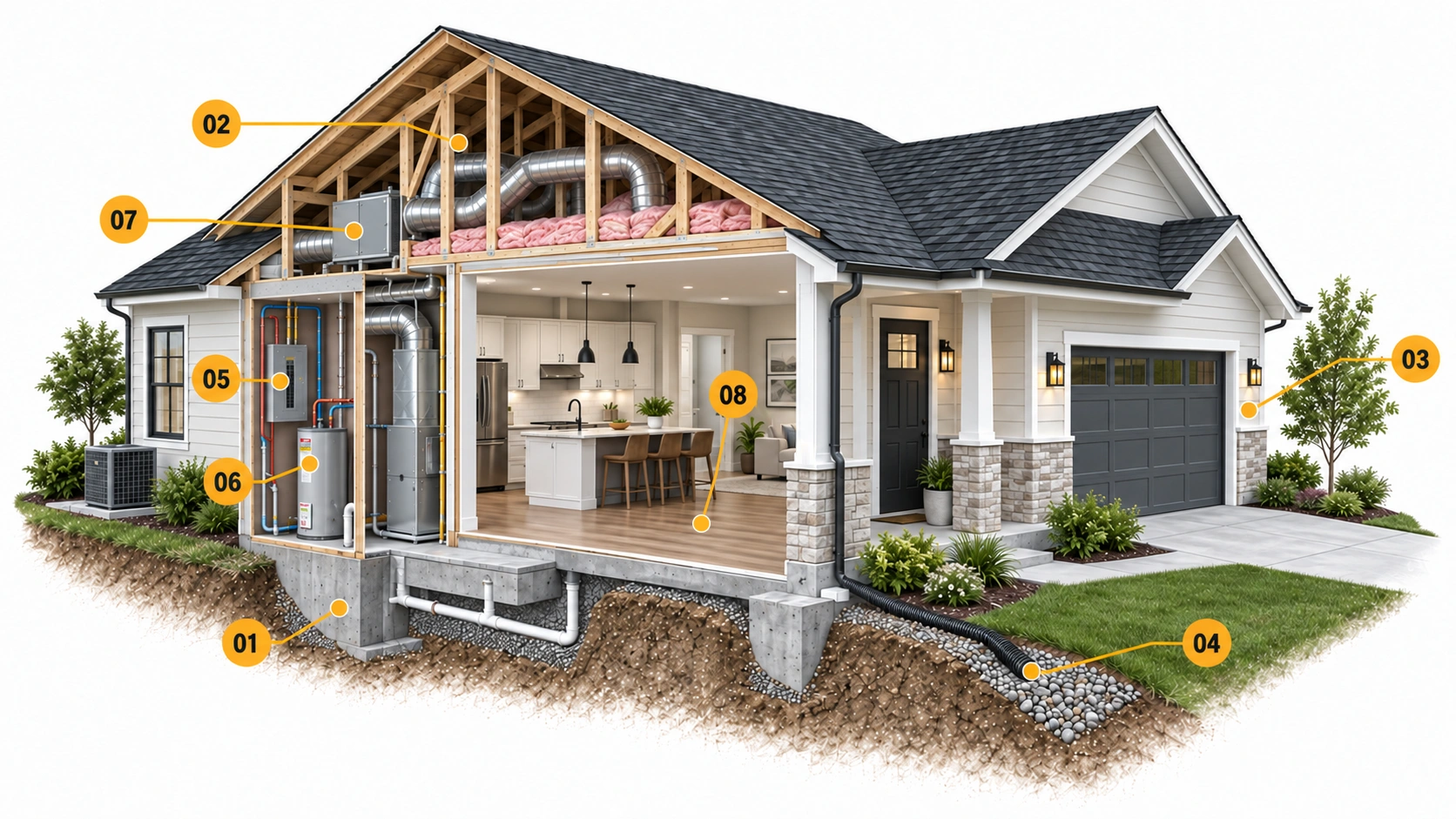
The inspection considers visible and accessible parts of the home’s major installed systems. Visibility, safe access, operating conditions and the agreed scope determine what can be evaluated.
The numbered points connect the categories below to parts of a house. They identify systems, not defects or inspection results.
- 01
Structure & foundation
Visible foundation and structural components, including framing that remains exposed and accessible.
- 02
Roof & attic
Visible roof coverings and related components, together with accessible attic conditions.
- 03
Exterior
Visible exterior coverings, openings, trim and attached exterior components.
- 04
Site & drainage
Visible grading, surface drainage and site conditions where they may affect the home’s structure.
- 05
Electrical
Accessible electrical service and distribution components, with installed lighting, switches and receptacles within the inspection scope.
- 06
Plumbing & water heating
Visible plumbing and water-heating components, including accessible piping, fixtures and faucets.
- 07
Heating & cooling
Installed heating and cooling equipment and visible air-distribution components.
- 08
Interior
Visible interior surfaces and installed components, including doors, windows and cabinetry. Appliance coverage follows the agreed scope.
STRUCTURE + INTERIOR SYSTEMS
- 01
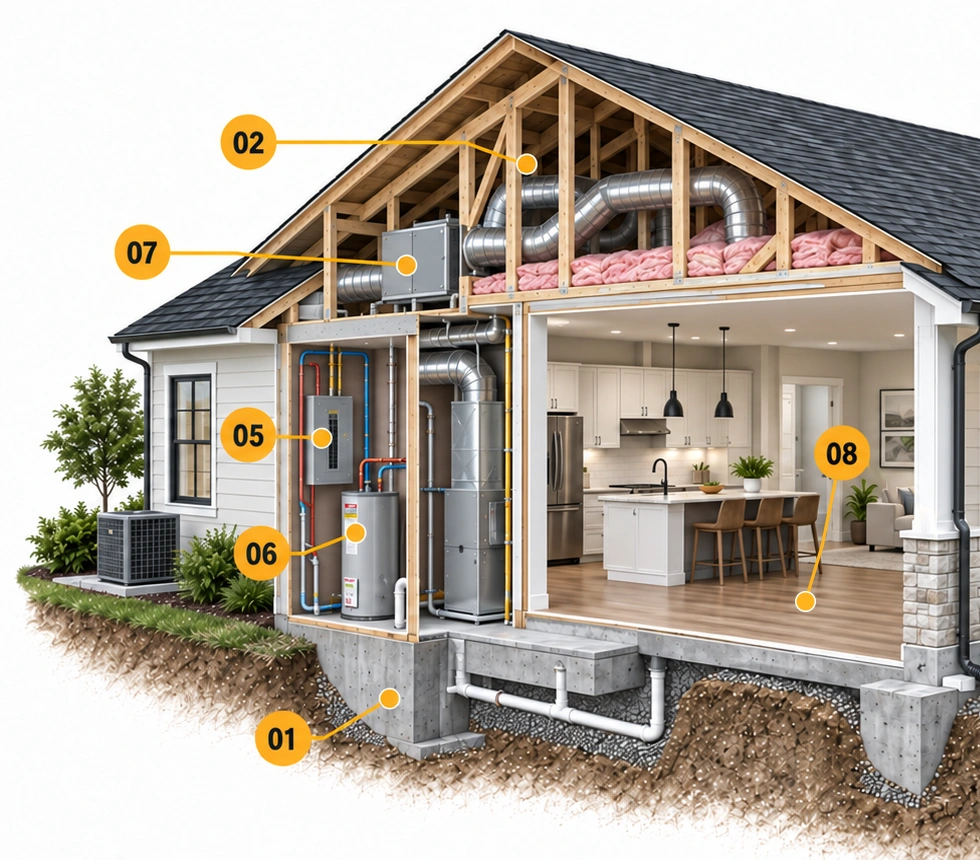
Structure & foundation
Visible foundation and structural components, including framing that remains exposed and accessible.
- 02
Roof & attic
Visible roof coverings and related components, together with accessible attic conditions.
- 05
Electrical
Accessible electrical service and distribution components, with installed lighting, switches and receptacles within the inspection scope.
- 06
Plumbing & water heating
Visible plumbing and water-heating components, including accessible piping, fixtures and faucets.
- 07
Heating & cooling
Installed heating and cooling equipment and visible air-distribution components.
- 08
Interior
Visible interior surfaces and installed components, including doors, windows and cabinetry. Appliance coverage follows the agreed scope.
EXTERIOR + SITE
- 03
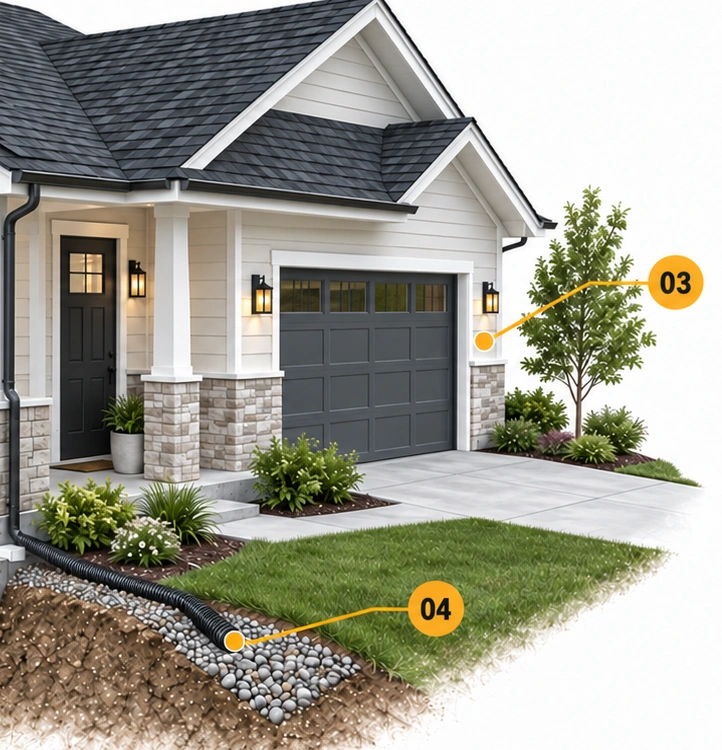
Exterior
Visible exterior coverings, openings, trim and attached exterior components.
- 04
Site & drainage
Visible grading, surface drainage and site conditions where they may affect the home’s structure.
Illustrative cutaway only. Walls and ground are opened in the drawing to explain the arrangement of systems. The inspection does not expose concealed construction. This is not an inspection finding, engineering drawing or code certification.
These categories are an overview, not an exhaustive checklist. The inspection agreement will define the service-specific scope, exclusions and limitations.
Read the full inspection overviewVISIBILITY, ACCESS + OPERATION
What can be seen. What can be checked.
A house may be occupied, furnished or partly inaccessible when it is inspected. Those conditions affect what can be observed and checked.
Visible and accessible
Finished walls, ceilings and floors are not opened to reveal concealed construction. Furniture, stored belongings and locked areas can restrict the available view.
Normal operation
Where appropriate to the agreed scope and safe conditions, installed systems are checked using their normal operating controls. This is not exhaustive testing of every mode or design performance.
Unavailable areas or systems
A blocked area, unavailable utility or shut-down system can limit evaluation. Present components that cannot be inspected are identified with the reason, rather than treated as satisfactory results.
A point-in-time record
The report describes conditions observed at the inspection visit. Concealed or intermittent conditions may remain undetected, and components can change after the inspection.
The inspection does not provide engineering analysis or code certification, and it does not guarantee future performance.
HOW WITNESS POINT COMMUNICATES
Findings, documented.
The written report gives you a record to review as you consider the purchase. It separates the observed condition, its practical significance and the appropriate next step.
OBSERVED
The condition and its location.
What was visible at the inspection visit, including significant deficiencies and relevant limits on the observation.
WHY IT MATTERS
The practical significance.
Why the observed condition warrants attention, without assuming what concealed work contains or predicting every future failure.
NEXT STEP
The appropriate action or further evaluation.
Correction, monitoring or evaluation by a qualified specialist, where the observed condition calls for it.
Read the limits as well as the findings.
Present systems or components that were not inspected are identified with the reasons. An unavailable view or check is a limitation, not a satisfactory inspection result.
Use the report to inform your next decision.
Review the significant concerns, the recommendations and any areas that could not be evaluated. Where further expertise is recommended, allow time to understand that evaluation before the relevant purchase deadline.
Discuss any purchase-related response with your agent or attorney under your agreement. The report does not require seller repairs, guarantee a credit or decide whether you should close.
Witness Point reports to you and does not perform or offer repairs on homes it inspects.
BUYER INSPECTION QUESTIONS
Before you arrange the inspection.
Answers about purchase timing, access, the written report and what an inspection can establish.
When should I arrange an inspection during a purchase?
Arrange it as early as practical after your offer is accepted and access can be coordinated. Leave time to review the findings and arrange any further evaluation before an inspection-related deadline in your purchase agreement.
Confirm the applicable dates and notice requirements with your agent or attorney. There is no single inspection period that applies to every purchase.
Does an appraisal replace a home inspection?
No. An appraisal provides an opinion of the property’s value. A home inspection examines the observable condition of its systems and components. They answer different questions, and an appraisal does not replace an independent home inspection.
What if utilities are off or access is blocked?
Tell us about known restrictions before the visit. Visible conditions can still be documented, but a blocked area or unavailable system cannot be evaluated as though it were fully accessible and operating.
The report identifies present systems or components that were not inspected and explains why. The appropriate timing and extent of the visit depend on the available access, operating conditions and agreed scope.
Will the inspection find every defect?
No. A visual inspection is limited by its scope, visibility, safe access and operating conditions. Finished materials are not removed to investigate concealed construction, and intermittent conditions may not appear during the visit.
The inspection is not an exhaustive cosmetic checklist or a guarantee against future failures.
What will the written report tell me?
It records observed conditions, explains their practical significance and identifies appropriate next steps. It also identifies present systems or components that were not inspected, with the reasons.
The report describes the inspection visit. It is not a prediction of every future condition or a substitute for specialist evaluation where that is recommended.
Does the report require the seller to make repairs?
No. The report documents observed conditions and recommendations; it is not a repair order or a guarantee of a credit, price change or right to cancel.
What the seller must do and what options are available depend on your purchase agreement and applicable obligations. Discuss the findings with your agent or attorney. Witness Point does not decide whether you should close.
Is this the right inspection for a townhome?
The ownership arrangement, maintenance responsibilities and access help determine the appropriate inspection boundary. The building’s appearance alone does not settle the choice.
A Buyer Home Inspection considers the home’s visible and accessible systems and components within the agreed scope. A Condo Unit Inspection focuses on the unit; common areas are outside the normal scope unless separately addressed.
Does Witness Point perform repairs?
No. Witness Point does not perform or offer repairs on homes it inspects. The company is paid to observe, inspect, document, and report, without a repair interest tied to what the inspection finds.
READY TO SCHEDULE?
Know what you are accepting before the decision is final.
Arrange an independent inspection of the home you’re buying. Have the property address and any inspection-related deadline available.